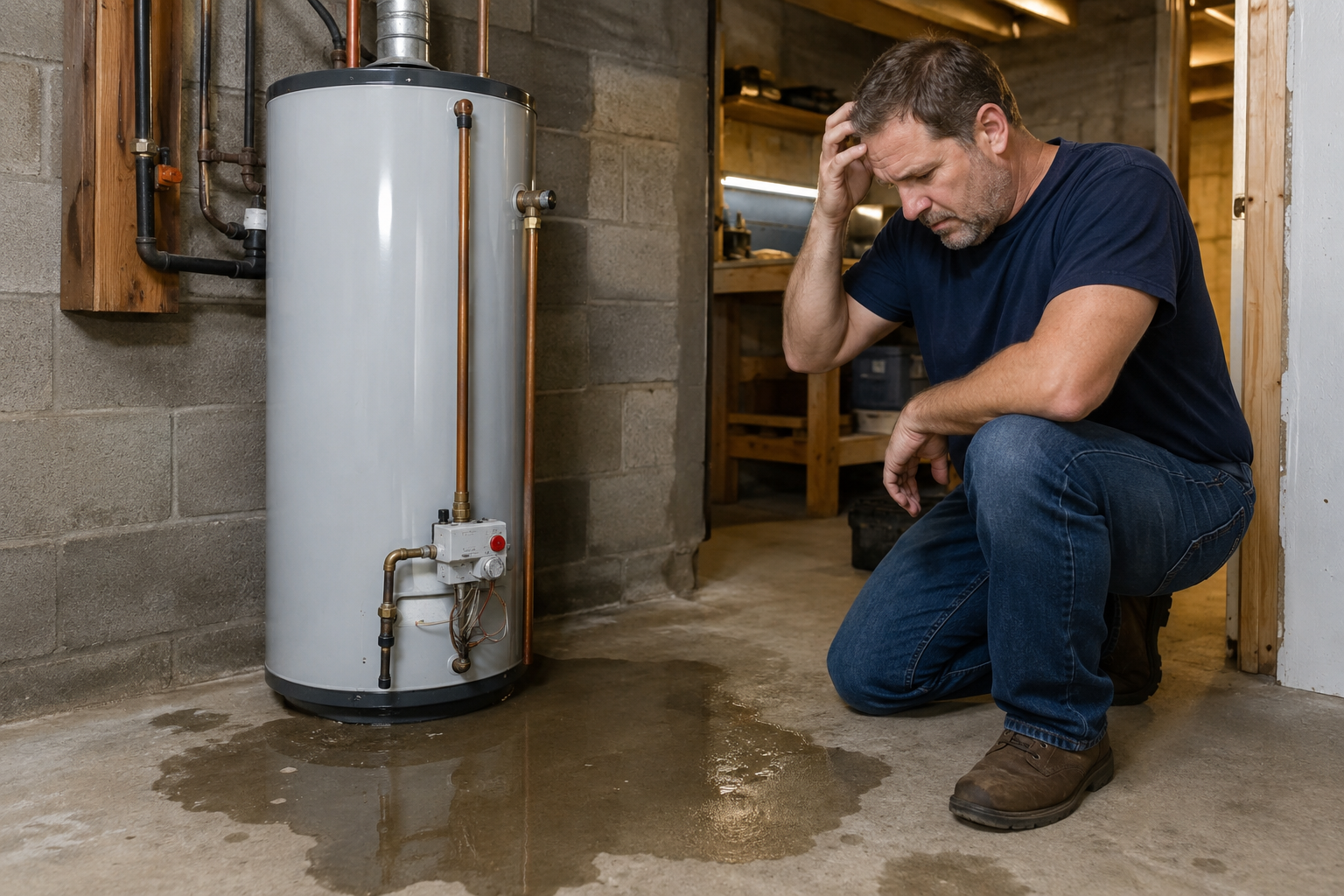
Finding a puddle under your water heater is unsettling, and for good reason. A leak coming from the bottom of the tank can mean anything from a simple loose fitting you can tighten in five minutes to a corroded tank that needs full replacement. The trick is knowing how to tell the difference quickly, because some causes are harmless and others will flood your basement if you wait too long. This guide explains what a bottom leak actually means, how to find the real source, what you can safely do yourself, and when it is time to call a Pittsburgh plumber.
First, Confirm the Water Is Actually a Leak
Before you assume the worst, rule out condensation. On humid days, or right after a large draw of hot water that brings cold water rushing into the tank, the cold surface can sweat and drip onto the floor. This is common in Pittsburgh basements during the warmer, damp months and is not a true leak.
To check, dry the area completely, then place paper towels around the base and check back in an hour or two. If the towels are soaked again and you find a steady reappearing puddle, you have a genuine leak that needs attention. If it is only a light film that takes a long time to return, condensation is the likely culprit.
Common Reasons a Water Heater Leaks From the Bottom
1. The Drain Valve Is Loose or Faulty
Near the base of every tank is a drain valve, used to flush sediment. If it is not closed tightly, or the washer inside has worn out, water will weep from it. This is one of the more minor causes. A loose valve can sometimes be hand-tightened, while a failed valve needs replacement, which a plumber can usually do without replacing the whole heater.
2. Sediment Buildup Has Corroded the Tank
Over years of use, minerals settle to the bottom of the tank. Pittsburgh’s water carries enough hardness that sediment builds steadily if the tank is never flushed. That layer traps heat, overworks the bottom of the tank, and eventually leads to corrosion and tiny cracks. When the tank itself has corroded through, the leak cannot be repaired and the heater must be replaced.
3. The Temperature and Pressure Relief Valve Is Discharging
The T&P relief valve is a safety device that releases water if pressure or temperature inside the tank climbs too high. Its discharge tube runs down toward the floor, so water near the bottom may actually be coming from this valve. If it is releasing often, that points to a pressure problem in your system that should be diagnosed rather than ignored, since the valve is protecting you from a dangerous buildup.
4. The Tank Has Reached the End of Its Life
Most tank water heaters last somewhere between 8 and 12 years. If yours is in that range or older and leaking from the body of the tank, age and internal corrosion are the most likely answer. At that point, replacement is almost always the smarter investment than repair.
How to Find the Real Source of the Leak
Tracing the leak to its origin tells you whether this is a small fix or a replacement. Work through these steps:
- Turn off the power. For an electric heater, switch off the breaker. For a gas heater, set the gas control to the pilot or off position.
- Shut off the cold water supply. Find the valve on the cold inlet line at the top of the heater and close it to stop more water entering the tank.
- Dry everything and inspect from the top down. Check the inlet and outlet connections at the top, then the T&P valve and its tube, then the drain valve at the bottom, and finally the body of the tank itself.
- Identify where the water originates. Connections and valves point to repairable problems. Water seeping from the tank body points to replacement.
What You Can Do Yourself, and What Needs a Plumber
A loose drain valve or a connection fitting at the top that has worked itself loose are reasonable things to check and gently tighten. Beyond that, water heater work involves gas lines, electrical connections, pressurized hot water, and local code requirements, all of which carry real risk if handled incorrectly.
Call a licensed plumber when the leak is coming from the tank body, when the T&P valve is discharging repeatedly, when you have a gas heater and smell gas, or when you simply are not sure what you are looking at. Our water heater services team in Pittsburgh can diagnose the source, tell you honestly whether repair or replacement makes more sense, and handle the work to code.
Water pooling under your heater and getting worse? Call Knight & Day Plumbing at (412) 887-5862. We respond 24/7 across Pittsburgh and give you a clear answer on repair versus replacement before any work begins.
How to Prevent Water Heater Leaks
Most bottom-of-tank leaks trace back to sediment and neglect, both of which are preventable with simple maintenance.
- Flush the tank once a year to clear sediment before it corrodes the bottom. In hard-water areas this is the single most valuable thing you can do.
- Check the anode rod every few years. This sacrificial rod corrodes in place of the tank, and replacing it on time can add years to the heater’s life.
- Test the T&P valve periodically by lifting its lever briefly to confirm it releases and reseats.
- Keep an eye on water pressure. Excess pressure stresses the tank and triggers the relief valve. A pressure-reducing valve can protect the whole system.
- Watch the age of your unit. As it passes 10 years, start planning for replacement so you are not caught off guard by a sudden failure.
Repair or Replace? A Practical Way to Decide
If the leak is a valve or fitting and the tank is under about 8 years old, repair is usually worth it. If the tank body is leaking, or the unit is past 10 years, replacement is the better long-term choice. A new high-efficiency model also lowers your energy bills, and choosing between a standard tank and a tankless system is a good conversation to have at replacement time. Our team walks Pittsburgh homeowners through that decision based on household size and budget rather than pushing the most expensive option.
Frequently Asked Questions
Is a leaking water heater dangerous?
A slow leak is mainly a water-damage risk, but a leak combined with a gas smell, or a relief valve discharging frequently, can signal a more serious safety issue. Shut off power and water and call a plumber promptly in those cases.
Can a leaking water heater be repaired?
It depends on the source. Leaks from valves, fittings, or the relief line can often be repaired. A leak from the tank body itself cannot be fixed and means the heater needs replacement.
How long do water heaters last in Pittsburgh?
Tank heaters typically last 8 to 12 years. Hard water shortens that range when the tank is not flushed regularly, while consistent maintenance pushes it toward the longer end.
What Water Heater Service Typically Involves in Pittsburgh
When a plumber arrives for a leaking water heater, the visit usually starts with a full inspection of the tank, its valves, and its connections to confirm the source before any work is quoted. For a repairable issue like a drain valve or a relief line, the fix is often completed the same day. For a tank replacement, the plumber drains and removes the old unit, checks that the existing connections and venting meet current code, and installs the new heater with any updates the code requires. In older Pittsburgh homes, that sometimes means bringing an outdated connection up to standard, which is worth doing properly rather than patching.
Honest providers give you a clear written estimate before starting and explain the difference in cost between a basic repair and a replacement so you can decide with full information. Be cautious of anyone who pushes an immediate full replacement without first diagnosing whether the leak is coming from a valve or the tank body itself.
Why Hard Water Makes This Worse in Our Area
Much of the Pittsburgh region has moderately hard water, and that hardness is a quiet driver of water heater failure. As water heats, dissolved minerals drop out of solution and settle as sediment on the bottom of the tank. Over the years that layer thickens, insulating the burner or element from the water, forcing the unit to run longer and hotter, and accelerating corrosion at the very bottom where leaks begin. This is exactly why annual flushing matters so much here, and why homes with a water softener often see their heaters last noticeably longer. If your heater has never been flushed, there is a good chance sediment is already shortening its life.
Pittsburgh’s Trusted Water Heater Experts
For more than 40 years, Knight & Day Plumbing has repaired, replaced, and installed water heaters for homes and businesses across Pittsburgh, South Hills, and North Hills. Our licensed and insured plumbers handle both tank and tankless systems, give you upfront pricing with no hidden fees, and back the work with a satisfaction guarantee.
Stop the leak before it damages your floors and walls. Call Knight & Day Plumbing at (412) 887-5862 for fast, honest water heater service anywhere in the Pittsburgh area.