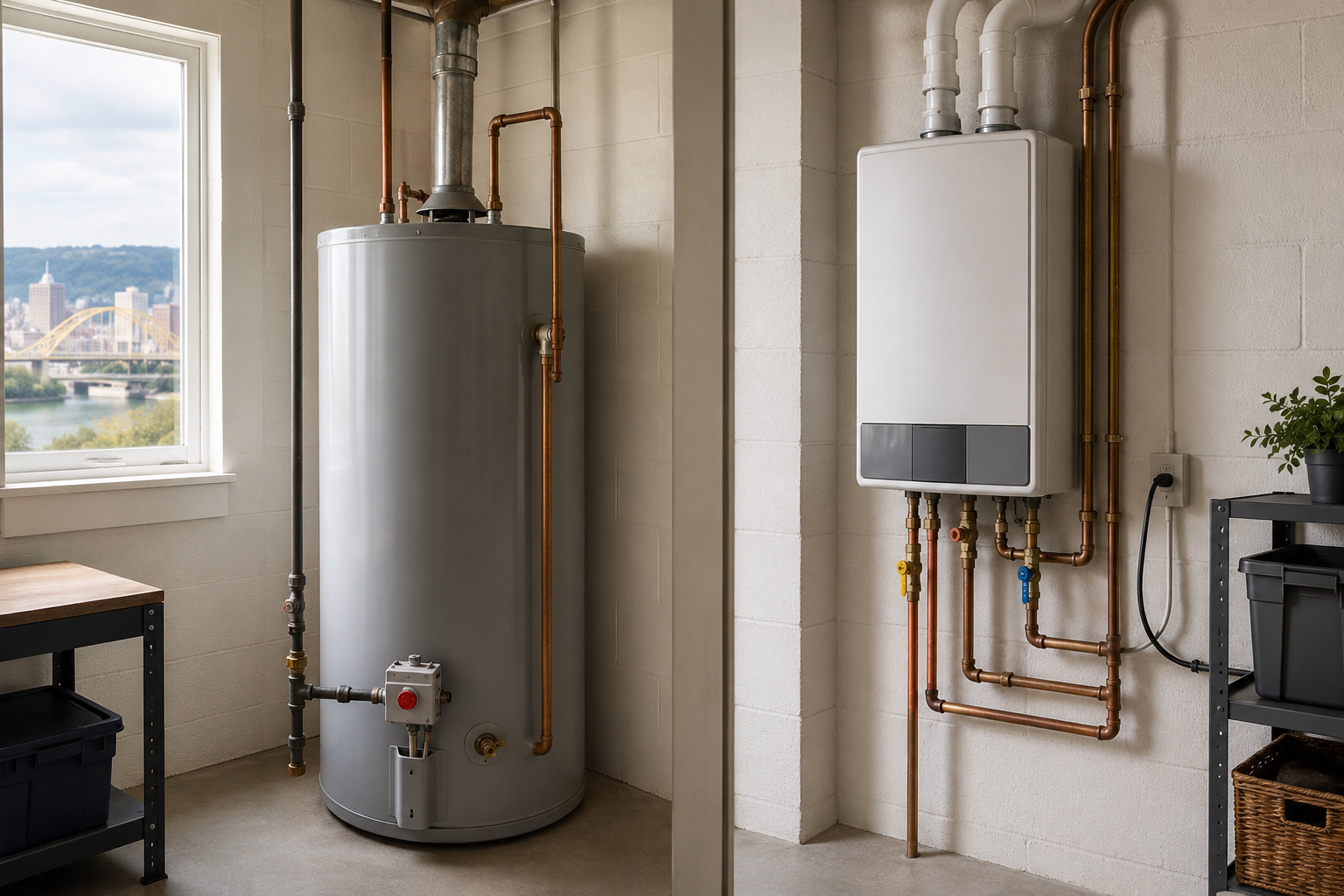
When it is time to replace a water heater, the first big decision is whether to stay with a traditional tank model or switch to a tankless system. Both heat your water reliably, but they do it in very different ways, with real differences in upfront cost, energy use, lifespan, and how much hot water you can use at once. There is no single right answer for every home. The best choice depends on your household size, your hot water habits, your budget, and even the layout of your house. This guide breaks down how each type works and weighs the honest pros and cons so you can decide with confidence.
Both options are widely used in Pittsburgh homes, and a good plumber will help you match the system to your needs rather than push the more expensive option. Here is what you need to know to have that conversation as an informed homeowner.
How Each Type Works
Traditional Tank Water Heaters
A tank water heater stores a large volume of water, commonly 40 to 50 gallons, and keeps it heated and ready in an insulated tank. When you turn on a hot tap, heated water flows out and cold water enters to be heated for next time. This is the system most homes have had for decades. Its strength is simplicity and a lower upfront cost. Its limitation is that once the tank is drained during heavy use, you have to wait for it to reheat, and energy is spent keeping the water hot around the clock even when you are not using it.
Tankless Water Heaters
A tankless heater, also called an on-demand heater, has no storage tank. Instead, it heats water instantly as it flows through the unit, using a powerful heat exchanger that activates only when you call for hot water. Because it does not store and constantly reheat a tank of water, it uses less energy over time and never runs out in the way a tank can. The tradeoffs are a higher upfront cost and a flow-rate limit, meaning a single unit can only heat so much water at once.
Comparing the Two: What Actually Matters
Upfront Cost
Tank heaters win clearly on initial price. The unit costs less and installation is usually simpler, especially when replacing an existing tank. Tankless units cost more to buy, and installation can be more involved, sometimes requiring upgrades to gas lines or electrical capacity and new venting. If the lowest upfront cost is the priority, a tank is the budget-friendly choice.
Energy Efficiency and Operating Cost
Tankless heaters are more energy efficient because they only heat water when you need it, avoiding the standby energy loss of keeping a full tank hot all day. Over the life of the unit, that efficiency lowers monthly energy bills. A tank heater is cheaper to install but costs more to run. The longer you stay in your home, the more the tankless efficiency works in your favor.
Hot Water Supply
This is where household habits matter most. A tank delivers a large burst of hot water but can run out during back-to-back showers or simultaneous demand, then needs time to recover. A tankless unit never runs out, supplying continuous hot water indefinitely, but it is limited by flow rate, so running several hot taps at once can strain a single unit. Large households with high simultaneous demand sometimes use multiple tankless units or a larger model to keep up.
Lifespan
Tankless heaters generally last longer, often 20 years or more with proper maintenance, compared to roughly 8 to 12 years for a tank. That longer life helps offset the higher upfront cost over time. The catch is that tankless units need regular descaling to reach that lifespan, especially in hard-water areas.
Space
Tankless units are compact and mount on a wall, freeing up the floor space a bulky tank occupies. In homes where basement or utility space is tight, that smaller footprint is a real advantage.
The Hard Water Factor in Pittsburgh
The moderately hard water common across the Pittsburgh region affects both types of heater, but in different ways. In a tank, minerals settle as sediment on the bottom, which insulates the burner or element, reduces efficiency, and shortens the tank’s life if it is never flushed. In a tankless unit, scale builds up on the heat exchanger and must be removed through periodic descaling to keep the unit running well and reach its long lifespan. Whichever system you choose, hard water means maintenance matters, and pairing either heater with a water softener can extend its life and protect the rest of your plumbing. This is worth factoring into the decision rather than discovering it later.
Which Should You Choose?
Here is a practical way to think about it.
A Tank Heater May Be Right If:
- You want the lowest upfront cost.
- You are replacing an existing tank and want a straightforward swap.
- Your household’s hot water use is moderate and rarely simultaneous.
- You may move in the next several years and will not recoup the tankless investment.
A Tankless Heater May Be Right If:
- You want lower energy bills over the long term and plan to stay in your home.
- You want endless hot water and dislike running out during back-to-back showers.
- You want to free up the floor space a tank takes.
- You are comfortable with a higher upfront cost in exchange for a longer-lasting, more efficient system.
For many households the decision comes down to how long you plan to stay and how you use hot water day to day. A plumber who looks at your home, your gas or electrical capacity, and your usage can give you a clear recommendation rather than a generic answer.
Not sure which water heater fits your home and budget? Call Knight & Day Plumbing at (412) 887-5862. We will assess your needs and give you an honest recommendation, anywhere in the Pittsburgh area.
Professional Installation Matters Either Way
Whichever type you choose, proper installation protects your investment and your safety. Water heaters involve gas lines or significant electrical loads, pressure relief, and venting that must meet local code. A correct installation ensures the unit runs efficiently, lasts as long as it should, and operates safely. In older Pittsburgh homes, a replacement sometimes requires bringing an outdated connection or vent up to current standards, which a licensed plumber handles as part of the job. Our water heater services team installs and services both tank and tankless systems across the region.
Frequently Asked Questions
Is a tankless water heater worth the extra cost?
For homeowners who plan to stay in their home for years, the lower energy bills and longer lifespan often justify the higher upfront cost. For those who may move soon or want the lowest initial price, a tank can be the more sensible choice. It depends on your timeline and usage.
Do tankless water heaters really never run out of hot water?
A tankless unit supplies continuous hot water and will not run out the way a tank can. Its limit is flow rate, so running many hot taps at the same time can exceed a single unit’s capacity. Sizing the unit correctly to your household prevents that.
How long do tankless water heaters last?
With regular maintenance, including descaling to manage hard water, tankless heaters often last 20 years or more, roughly double the lifespan of a typical tank heater.
Maintenance Requirements Compared
Both types of water heater last longer and run better with regular maintenance, but the specifics differ. A tank heater benefits most from an annual flush to clear sediment from the bottom, along with periodic checks of the anode rod and the temperature and pressure relief valve. Skipping the flush is the most common reason tanks fail early in hard-water areas. A tankless heater needs periodic descaling to remove the mineral scale that forms on the heat exchanger, which is essential to reaching its long lifespan, plus occasional cleaning of the inlet filter. Neither maintenance routine is difficult, but both matter. When you weigh the two systems, factor in that the tankless unit’s longer life depends on keeping up with descaling, while the tank’s shorter life can be stretched toward its maximum with annual flushing.
Making the Investment Over Time
It can help to think of a water heater as both an upfront purchase and an ongoing operating cost. A tank heater costs less to buy and install, but spends more on energy every month and is replaced sooner. A tankless heater costs more at the start, but spends less on energy and lasts roughly twice as long. The longer you plan to stay in your home, the more the tankless math improves, because you have more years to recover the higher upfront cost through lower bills and a delayed replacement. For a homeowner planning to stay put for a decade or more, that long horizon often tips the decision toward tankless. For someone who may sell within a few years, the lower upfront cost of a tank usually makes more sense. There is no universally correct answer, only the one that fits your situation.
Pittsburgh’s Water Heater Experts
For over 40 years, Knight & Day Plumbing has installed and serviced water heaters of every type for homes and businesses across Pittsburgh, South Hills, and North Hills. Our licensed and insured plumbers help you choose the right system for your needs, install it to code, and stand behind the work with upfront pricing and no hidden fees.
Make the right choice for your home’s hot water. Call Knight & Day Plumbing at (412) 887-5862 for expert water heater guidance and installation throughout the Pittsburgh area.