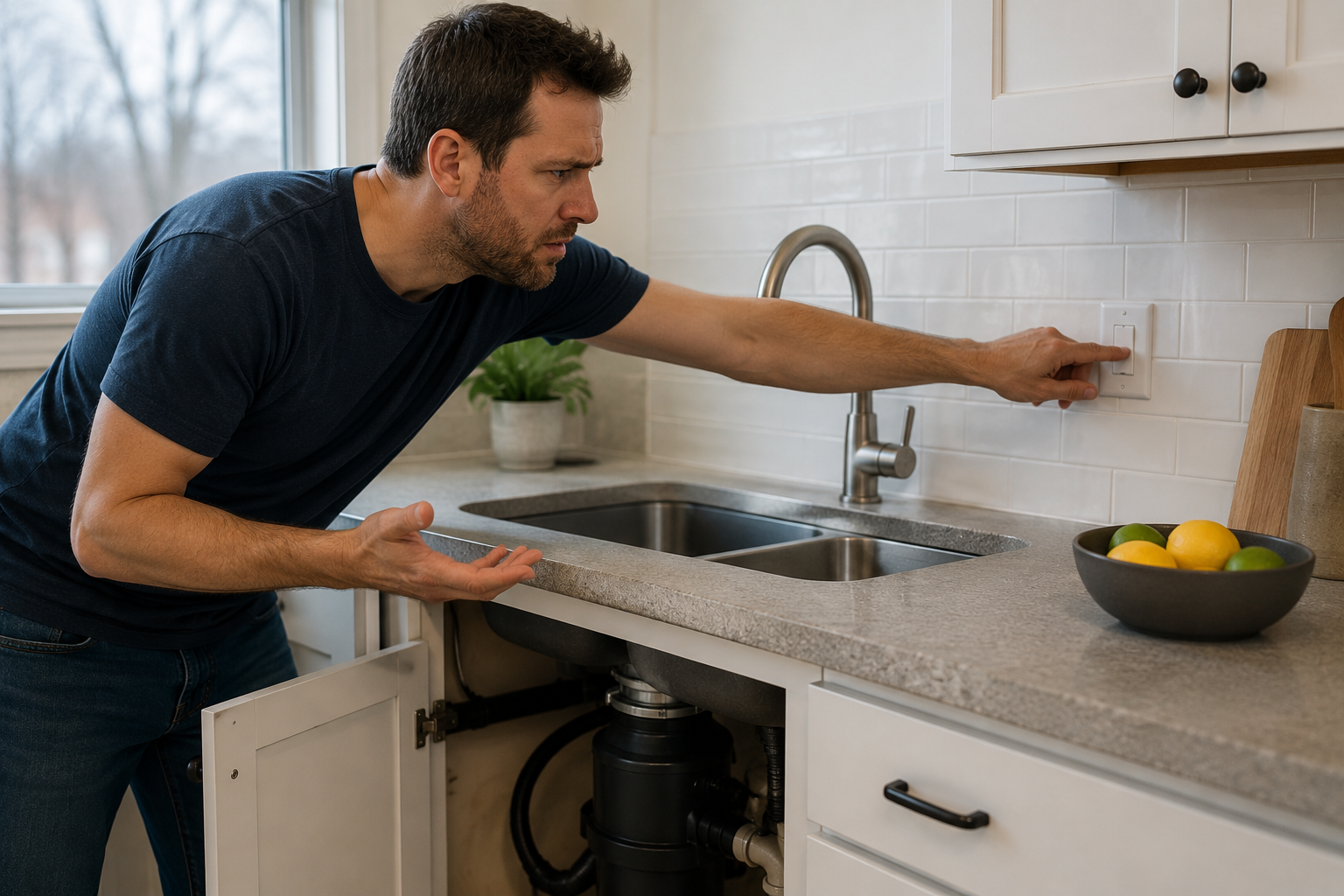
A garbage disposal that refuses to turn on is one of the most common kitchen plumbing headaches, and the good news is that many of the causes are simple enough to fix yourself in a few minutes. Before you assume the unit is dead and start shopping for a replacement, it is worth working through a short troubleshooting sequence. More often than not, the problem is a tripped reset button or a blown circuit rather than a failed motor. This guide walks you through every step in the right order, explains what each symptom means, and tells you when it is genuinely time to call a Pittsburgh plumber.
One safety note before you begin: never put your hand down into the disposal. Even when it seems completely dead, treat the unit as if it could start at any moment and keep your fingers out of it entirely.
Start by Identifying the Symptom
Disposals fail in two distinctive ways, and which one you have tells you where to start.
- Completely silent: You flip the switch and nothing happens at all, no sound, no hum. This usually points to a power problem, such as a tripped reset, a tripped breaker, or a wiring issue.
- Humming but not spinning: You hear a hum when you flip the switch, but the blades do not turn. This almost always means the unit is jammed, with something stuck between the impellers and the grinding chamber.
Match your situation to one of these, then follow the matching steps below.
If the Disposal Is Completely Silent
Step 1: Check That It Is Getting Power
Make sure the unit is plugged in under the sink. Plugs can vibrate loose over time, and a disposal that lost its connection will be silent. While you are there, confirm the switch on the wall is the one that controls the disposal and not a light or another fixture.
Step 2: Press the Reset Button
Every disposal has a reset button on the bottom of the unit, usually a small red or black button. When the motor overheats or overloads, it trips this internal breaker and shuts off to protect itself. Reach under the sink, find the button, and press it firmly until it clicks and stays in. This single step solves a large share of dead-disposal calls. Wait a few minutes for the motor to cool first if it was running hard before it quit.
Step 3: Check Your Home’s Circuit Breaker
If the reset button did not help, go to your electrical panel and look for a tripped breaker. A breaker that has shifted to the middle or off position needs to be switched fully off and then back on. Disposals sometimes share a circuit with other kitchen outlets, so a breaker can trip from a combined load.
Step 4: Test the Switch and Outlet
If the unit is plugged into an outlet controlled by a GFCI, that GFCI may have tripped. Look for a reset button on a nearby kitchen or bathroom outlet and press it. If power is confirmed and the unit is still silent after a reset, the switch, outlet, or the disposal’s internal wiring may have failed, which is the point to bring in a professional.
If the Disposal Hums but Won’t Spin
A hum means the unit has power but something is physically blocking the blades. Forcing it will burn out the motor, so clear the jam instead.
- Turn off the disposal at the wall switch and unplug it under the sink. Do not skip this. The unit must be fully powered down before you reach near it.
- Look inside with a flashlight. You may spot a bone, a fruit pit, a utensil, or a buildup of fibrous food caught in the chamber.
- Remove the obstruction with tongs or pliers, never your fingers. Pull out whatever is wedged in there.
- Free the flywheel from below. Most disposals come with a small hex wrench that fits a slot in the center of the bottom of the unit. Insert it and turn back and forth to manually rotate the blades and break the jam loose. If you do not have the wrench, the slot fits a standard Allen key.
- Restore power, then press the reset button, and test the unit. With the jam cleared and power restored, flip the switch and confirm the blades now spin freely.
When to Stop and Call a Plumber
Some disposal problems are beyond a quick fix, and pushing further can cause damage or injury. Call a professional when:
- The unit is silent even after checking power, pressing reset, and resetting the breaker and GFCI.
- It still hums after you have cleared the chamber, which can mean a seized motor.
- You see water leaking from the disposal body or its connections.
- There is a burning smell, which signals electrical or motor trouble.
- The unit is old, frequently jams, or has simply stopped grinding effectively even when it runs.
At that point, repair or replacement is the right call, and a plumber can tell you which makes more sense. Our garbage disposal services team in Pittsburgh handles jammed units, failed motors, leaks, and new installations quickly and cleanly.
Tried everything and the disposal still won’t run? Call Knight & Day Plumbing at (412) 887-5862. We will get your kitchen back in order fast, anywhere in the Pittsburgh area.
How to Keep Your Disposal Running Well
A few habits prevent most jams and motor failures and extend the life of the unit.
- Run cold water before, during, and after grinding to flush waste through and keep the motor cool.
- Avoid fibrous foods like celery, corn husks, and onion skins, which wrap around the blades.
- Keep grease, oil, and fat out of the disposal, since they solidify and cause clogs downstream.
- Never put bones, fruit pits, or hard items in the unit, as they jam the impellers.
- Grind small amounts at a time rather than packing the chamber full.
- Clean it regularly by grinding ice cubes and a little citrus peel to clear buildup and freshen the unit.
Frequently Asked Questions
Why does my garbage disposal hum but not work?
A hum with no spinning almost always means the unit is jammed. Power is reaching the motor, but something is blocking the blades. Cut the power, clear the obstruction, and use the hex wrench on the bottom to free the flywheel.
Where is the reset button on a garbage disposal?
It is on the bottom of the unit, usually a small red or black button in the center. Press it firmly until it clicks and stays in. This resolves many cases where the disposal goes completely silent.
Is it worth repairing a garbage disposal?
If the unit is relatively new and the problem is a jam or a tripped reset, it is absolutely worth keeping. If it is older, leaking, or the motor has failed, replacement is usually the better value, and a new unit installs quickly.
Understanding Why Disposals Fail in the First Place
Most disposal failures are not random. They trace back to how the unit is used day to day. The motor is protected by a thermal overload that trips when the unit works too hard, which is why overloading the chamber or grinding tough material so often leads to a dead disposal that just needs a reset. Jams come from items the unit was never meant to handle, and leaks tend to develop at the connections or from a cracked body after years of service. Understanding these patterns helps you both fix the current problem and avoid the next one.
It also helps explain why two identical disposals can have very different lifespans. A unit treated gently with cold water and the right foods can run well past a decade, while one fed bones, grease, and fibrous scraps may struggle within a few years. The mechanical part of the disposal is simple and durable. It is usually the habits around it that determine how long it lasts.
Repair Versus Replacement for Disposals
Garbage disposals are one of the more affordable pieces of kitchen equipment, which shapes the repair-or-replace decision. If a relatively new unit is jammed or tripped, clearing it costs nothing and it is clearly worth keeping. If an older unit leaks from the body, has a seized motor, or has simply lost its grinding power, replacement is often close in cost to a significant repair and gives you a fresh, more efficient unit with a new warranty. A plumber can install a new disposal quickly and make sure the connections and the dishwasher line are properly sealed, which is a common spot for leaks when units are swapped without care.
Pittsburgh’s Kitchen Plumbing Specialists
With more than 40 years serving Pittsburgh, South Hills, and North Hills, Knight & Day Plumbing repairs and installs garbage disposals along with the full range of kitchen plumbing. Our licensed and insured plumbers offer upfront pricing, fast service, and honest guidance on whether to repair or replace, with no hidden fees.
Get your disposal working again without the guesswork. Call Knight & Day Plumbing at (412) 887-5862 for reliable kitchen plumbing service throughout Pittsburgh.